

Why Is It Important For Our Experiment That The Surfaces Be Clean And Dry?
The purpose of this document is to present the electric current knowledge on cleaning and disinfecting surfaces in indoor and outdoor environments, specifically in residential settings and public spaces and excluding healthcare facilities and other healthcare settings, as well as on health issues related to cleaners and disinfectants and the suggested "quarantining" of objects. The information summarized in this document is based on a non-comprehensive review of the grey and scientific literature. The sections in yellow are significant updates made on the indicated date, based on the gray literature bachelor as at Apr 26, 2022. Complete information on the methodology used to create this document is presented in Appendix 1.
Persistence of the SARS-CoV-2 virus on surfaces and fomite transmission
Detection and persistence of the virus on surfaces and inanimate objects
In real atmospheric condition, the SARS‑CoV‑2 virus, or its genetic fabric (RNA), take been detected on surfaces in a number of studies conducted in healthcare settings (3–22) and in the customs (14,23–28). It is by and large reported that the environment is nigh contaminated well-nigh infected individuals and on the surfaces they ofttimes touch (iv–vi,23). However, no enquiry teams have been able to cultivate the virus when present on surfaces in not-experimental settings (5,9,13,19,24,29).
Depending on the surfaces examined, unlike authors have reported a varying elapsing from a few hours to a few days in which the virus was cultivable in experimental weather. The duration was longer on stainless steel (48 hours) and plastic (72 hours), and shorter on paper-thin (24 hours) and copper (4 hours) (30). Chin et al. (2020) have reported detecting the virus for a period of up to iii hours following inoculation on rougher surfaces like paper and fabric, and vii days on smoothen surfaces similar plastic and steel (31). The virus remained cultivable for less than 24 hours on bank notes and wear (32). Liu et al. (2020) have reported that SARS‑CoV‑two remained cultivable for 7 days on plastic, stainless steel, glass, ceramic, wood, latex gloves, and surgical masks, but that no virus could exist cultivated from cotton fiber vesture subsequently four days or from paper after v days (33). The virus therefore generally appears to survive longer on smooth surfaces than on porous surfaces in a lab (31,33). Information technology is important to annotation that the experimental conditions recommended by the previously cited authors are most ofttimes more than favourable to the persistence of the virus than field conditions, which did not allow for cultivation of the virus.
Preservation of the virus on surfaces depends on a number of factors including ecology conditions like temperature and relative humidity. In outdoor environments, preservation is generally affected by wind speed, atmospheric precipitation, and the intensity of ultraviolet (UV) rays (34). With regard to UV rays, laboratory experiments have indicated that the SARS‑CoV‑2 virus has a very quick inactivation rate in aerosols in sunlight, with a half-life of less than half dozen minutes and 90% of the virus inactivated inside 20 minutes at varied sunlight intensities (35). UVC radiation has also been demonstrated as effective at inactivating SARS‑CoV‑2 in a virus intermission (36).
Virus manual through contact with surfaces and inanimate objects
To date, few epidemiological studies have shown that COVID‑19 tin can exist transmitted via fomites (37–41). The specifications required to demonstrate this link are complex, especially since it is difficult to fully exclude other possible means of transmission. Ane experimental written report on hamsters established that SARS‑CoV‑two can be transmitted betwixt these animals via contaminated surfaces (42). While no clear man transmission specifically attributable to contact with fomites has been identified in the literature, the World Health Organisation (WHO) (43–45) and a number of scientific literature reviews (46–50) have ended that this form of transmission remains possible. The Centers for Illness Control and Prevention (CDC) consider the risk of SARS-CoV-2 transmission via fomites to be low (51).
Prevention and control measures
The prevention and control measures generally recommended in a pandemic context, such as minimizing contacts, physical distancing, hand hygiene, use of respiratory etiquette, and mask-wearing are considered essential for reducing the risk of contracting SARS‑CoV‑2. As well, cleaning is facilitated past limiting ataxia and removing not-essential objects that are difficult to clean (52).
Cleaning and disinfection
- Wet cleaning methods (e.g., with a clean, damp cloth or wet mop) are preferable to dry methods (dusting and sweeping), as they are less probable to resuspend infectious aerosols in the air (1).
- The cleaners and disinfectants unremarkably institute on the market and approved by Health Canada are constructive confronting the virus that causes COVID-19one(53,54).
- Information technology is important to always follow the manufacturer'south instructions for using these products and not to mix different products, equally such solutions can generate irritating and noxious fumes. It is also important to ensure that the product is in contact with the surface to exist disinfected for a sufficient amount of time. This contact fourth dimension is normally specified by the production manufacturer (55).
- The nearly frequently touched surfaces (door handles, armrests, tables, light switches, remote controls for electronic equipment, water faucets, elevator buttons, handrails, toilets, etc.) are more than likely to exist contaminated by SARS-CoV-two. Particular attention must exist paid to the frequency and rigorous effectiveness of their cleaning and disinfection, as needed.
- For porous surfaces such equally carpets and curtains, any visible contamination, when present, must be eliminated using suitable cleaning products specified for utilise on these surfaces. After cleaning, if the articles can be washed, information technology is recommended to exercise then in accordance with the manufacturers' instructions using the maximum h2o temperature recommended for these articles, if possible (1,56), and to then dry out them completely later.
Health bug associated with cleaning products and disinfectants
Between March and June 2022, in that location was a meaning increase in telephone calls to Canadian poison command centres regarding exposure to disinfectants for surfaces and hands (e.thousand., bleach, chlorine/chloramine gas) compared to the same catamenia in 2022. The rapid increase in calls in the third week of March 2022 coincides with the WHO declaring the international pandemic and is consistent with results gathered in the United States (57). Data collected from 55 American poison control centres too showed a significant increase in calls (20.4%) regarding cleaning products and disinfectants from January to March 2020, compared to the same period in 2022, with the number of cases primarily increasing in March 2022. Diluted bleach solutions (62.one%) and booze-costless manus sanitizers (36.7%) were the primary causes of this increase. Cases of inhalation exposure specially increased, both for cleaning products (35.three%) and for all disinfectants (108.8%) (58).
A recent study, also from the United states of america, may partly explain these increases. A survey of citizens' knowledge and behaviours regarding cleaning and disinfection related to the COVID-19 pandemic showed that a tertiary of respondents reported risk behaviours, such as cleaning nutrient products with bleach, applying disinfectants to skin that were non designed for this use, or inhaling or even intentionally ingesting cleaning products or disinfectants. The authors ended that in that location is a need to inform citizens about safe cleaning and disinfection practices (59).
The use, and peculiarly the inappropriate use, of cleaning products and disinfectants can cause astute wellness problems. A notable example is mixing bleach with other ammonia- or acid-based products. In the former case, the mixture can produce chloramine gases that may cause respiratory effects in persons exposed, including shortness of breath, wheezing, and irritation of the optics, throat, and nose, etc. In the latter, chlorine gas can be produced, with as harmful respiratory consequences (sixty).
Regarding possible chronic wellness problems, epidemiological data have shown an clan between the utilize of cleaning products and disinfectants in the workplace (61) and at home (62,63) with the development and exacerbation of asthma. An international study has likewise established a relationship betwixt the use of household cleaning sprays and the incidence of developed asthma (62).
Cleaning and disinfecting oft touched objects and surfaces (run into Method for cleaning and disinfection), as needed, are recommended and necessary prevention and control measures in the fight confronting COVID-nineteen. However, because the increase in acute effects related to exposure to cleaning products and disinfectants observed in Canada (57) and the United states of america (58) in the spring of 2022 and that possible inappropriate apply of these products has been demonstrated (59), there is practiced reason to emphasize their prophylactic use. In detail, it is of import to follow the manufacturers' instructions and to avoid mixing products (see Prevention and control measures – Cleaning and disinfection; tertiary point), to respect protective measures (come across Advisable protective measures for cleaning and disinfection), and to continue cleaning and disinfection products out of the attain of children (see Method for cleaning and disinfection; fifth point). People who are more vulnerable to the effects of these products (eastward.grand., people with asthma) may want to take additional protective measures such as avoiding the apply of these products or only using them when necessary, staying in another room while the products are being used, and choosing the least risky products available (64). Following these guidelines tin can reduce the risks linked to virus exposure while preventing the risks associated with cleaning and disinfection products.
Method for cleaning and disinfection
- It is necessary to utilize paper towels or clean cloths for cleaning.
- As disinfectant is less effective on a soiled surface, clean the surface with water and lather or detergent to starting time eliminate whatsoever debris or stains (65,66); rinse with clean h2o and dry with a make clean towel; apply the disinfectant as needed; then leave the disinfectant solution to deed for a few minutes (according to the manufacturer's instructions) before wiping off all traces of the product with a clean cloth. After disinfecting with a diluted water and bleach solution, rinse any surfaces that may come up into contact with food or any object that may touch a person'south mouth or eyes (67). Offset by cleaning the cleanest areas and finish with the dirtiest areas (68). All often touched surfaces must be cleaned regularly.
- Electronic devices, such as computer keyboards, tablets, and cell phones, can be disinfected with commercial pre-soaked booze wipes (at least once daily) or follow the manufacturer's recommendations for cleaning and disinfection products suitable for the device.
- In indoor public spaces, oftentimes touched surfaces must exist cleaned at least once daily and, if possible, more frequently depending on the intensity of their utilize (1,64,69). They must as well been cleaned as shortly as they are visibly dirty. Surface cleaning is particularly of import in common areas like bathrooms and kitchens (1,52,66). It is non necessary to systematically disinfect later cleaning, except in specific situations (see the following indicate) (64,66,68,70). By eliminating dirt and impurities, cleaning is considered to eliminate 90% of the microorganisms present on surfaces (31,65–68). Cleaning is in fact considered the virtually of import pace of the consummate pathogen elimination process (71).
- Disinfection must be carried out when an individual infected with COVID-19 or presenting symptoms uniform with the disease has stayed in the room (encounter Method for cleaning and disinfecting inanimate objects and surfaces in places where infected people take stayed) (64,68,lxx). Disinfectants with a drug identification number (DIN) are recommended for this purpose (1). Kampf et al. (2020) accept demonstrated that bleach solutions (sodium hypochlorite diluted to 0.ane% to 0.5%), ethanol (62% to 71%), and hydrogen peroxide (0.v%) were very constructive for disinfecting surfaces contaminated with coronavirusesii(72). To set up a bleach solution diluted to 0.ane% using basic household bleach (with a 5% concentration), one part bleach is added to 50 parts h2o.3 This concentration is considered adequate for disinfecting difficult (non-porous) surfaces. The minimum recommended contact time is i minute. This solution must exist prepared daily and, as with all cleaning products and disinfectants, stored safely out of the accomplish of children.
- Environments that applied cleaning and disinfection procedures before the pandemic (e.m. slaughterhouses) must continue these procedures during this menstruum.
- Shared objects and equipment must be reserved for a single group (organize objects and equipment by group of individuals) so that they can be cleaned but once daily. If information technology is not possible to reserve the equipment for a single grouping, it is suggested, as set up out in the INSPQ document on daycare facilities (73) [in French only], that the equipment be cleaned between each group of users. This recommendation applies to daycare centres, schools, and workplaces, excluding healthcare settings.
- If possible, one should avoid using spray bottles (2,74) to limit aerosolization of disinfectants, which could be inhaled and irritate the airways and cause respiratory problems (ii,62,74,75). Withal, if a spray bottle is used, adjust information technology to a spray setting with large aerosol (74).
Appropriate protective measures for cleaning and disinfection
- Wear waterproof gloves for hand protection when cleaning (64).
- Hands must be washed before and subsequently wearing gloves. Wash easily with water and soap (for at least twenty seconds) after removing gloves (76).
- Brand sure to properly ventilate the room during cleaning and disinfection operations (64).
- After the cleaning and disinfection, carefully launder washable gloves with water and detergent and and then dry them, or discard and supplant the gloves with a new pair, equally applicable.
- Once the cleaning and disinfection operations are complete, remove the non-disposable personal protective equipment used, if applicative, and wash information technology (74).
- Wear an RPD (respiratory protective device) when warranted and every bit specified in the product manufacturer'south instructions.
Method for cleaning and disinfecting inanimate objects and surfaces in places where infected people have stayed
- The cleaning procedures must exist optimized in areas where infected people have stayed for hours at a fourth dimension. It is suggested that the premises be cleaned and disinfected, especially objects and surfaces infected individuals have touched (77). The usual cleaning products and disinfectants may be used to carry out these tasks.
- "The available experimental and epidemiological data back up aerosol transmission in shut proximity (within ii meters). The gamble of SARS-CoV-ii manual increases in closed, crowded and, inadequately ventilated spaces, and with prolonged exposure. The information accept demonstrated that manual by close contact remains the master transmission vector involved. All the same, they likewise suggest that aerosol transmission could occur at a distance. The maximum distance remains inexact, just it is unlikely to exist more than a few meters" (78). At present, the scientific community cannot exactly determine the actual persistence time of the virus in open up air (thirty,79). However, it has been observed in an experimental situation that the median half-life of SARS-CoV-ii in aerosols was approximately 1 60 minutes (30). Too, because that the recommendations in this certificate are mainly intended for residential, customs, and work settings (excluding healthcare settings) where the clinical condition of the infected individual and ventilation situation of the bounds are often unknown, disinfection measures are maybe less rigorous than in a healthcare setting, and in that location is often lilliputian or no personal protective equipment available, information technology is recommended to close, every bit much as possible, the areas used by infected individuals and to wait one hour (as a precaution) before starting cleaning and disinfection (fourscore). If possible, optimize the fresh air intake past the mechanical ventilation system or open the windows to the outside to increase the air circulation in the area concerned. This waiting catamenia will also help promote the gradual inactivation of the virus on surfaces.
- For difficult and not-porous surfaces, the usual cleaning products and disinfectants can exist used to carry out cleaning tasks. Allow the disinfectant to have sufficient contact time with the surfaces or objects to inactivate the virus (refer to the manufacturer's specifications for this information).
- For porous surfaces such equally carpets and curtains, eliminate any visible contamination, when nowadays, while cleaning with products suitable for utilise on these surfaces. After cleaning, if the articles can exist washed, wash them in accordance with the manufacturers' instructions using the hottest water appropriate for these articles, if possible (1,56), and so dry them completely afterward.
- Apparel and other articles that go in the laundry may be washed using the hottest water recommended for these articles, when possible (56). Take soiled linen (east.1000., sheets, towels, wearing apparel) to the laundry expanse in a material or plastic handbag. Avert shaking the laundry or the container while placing the laundry in the washing machine. Avoid contact betwixt skin or clothing and the contaminated laundry. The laundry tin however exist washed with laundry from other members of the household or facility concerned, using a regular laundry detergent. However, if the wearing apparel are heavily soiled (due east.g., with vomit), they must be cleaned beforehand or even washed separately.
- The infected private'due south dishes and utensils tin be washed after employ in the usual manner with soap and water. Using a dishwasher is as well acceptable.
- Tissues and disposable items used by the infected individual must be disposed of in a garbage bin equipped with a bag and ideally, a comprehend. Close the bag before disposing of it in the container used for regular garbage collection.
Cleaning and disinfection in outdoor environments
- Every bit gear up out in the publication COVID-19: Outdoor surround (34), SARS‑CoV‑two transmission via contaminated inanimate objects and surfaces (fomites) is considered possible despite limited epidemiological evidence. In outdoor environments, the presence of SARS‑CoV‑ii on objects and surfaces tin can be affected by various factors (sunday radiation, wind, precipitation, temperature, humidity, etc.). "In social club to reduce the risk of transmission via fomites, the various surfaces of street furniture can exist cleaned in the usual fashion and by and large do non require disinfection" (34).
- Using disinfectant in aerosol form (spraying, fumigation) in outdoor spaces (e.chiliad., streets, market squares) is non recommended in the context of COVID-19 (2,81). This method has not been proven effective at reducing the hazard of infection and carries risks for the surround and the staff carrying out the work, as some products used tin crusade irritation to the airways (82).
- For cleaning operations related to indoor and outdoor recreational activities, refer to the guidelines and recommendations issued by recognized organizations (83-86).
Quarantining items shared between groups that cannot be cleaned or disinfected
- Sharing objects between groups should exist limited as much equally possible in the context of a pandemic, peculiarly whatsoever objects that come up in contact with a person's confront or caput.
- If sharing objects between groups cannot exist avoided, it may exist recommended to remove or shop (quarantine) shared materials that cannot be cleaned and disinfected (encounter Effigy 1) (87).
- Some situations may or may not require a quarantine, either for all alert levels or only in red zones. The proposed recommendations for these various scenarios are described below (see Figure i).
- A number of factors may influence these recommendations: the take chances of infected persons, whether symptomatic or not, existence present; the risk of contagion of objects past respiratory secretions (that is the master means of viral emission); the number of people potentially in contact with the object; vaccination status; and the ability to comply with recommended hygiene measures; to name a few.
- Under experimental weather, the length of time that the virus remains cultivable varies depending on the material of the object or surface. Objects may also be fabricated of more than 1 type of material. In order to account for the diverse types of materials on which the virus has a slightly longer half-life (e.g., plastic compared to paper or clothing), it is by and large suggested that the minimum length of quarantine be 24 hours, where applicable (see below and Figure i).
- For article of clothing used in plumbing fixtures rooms in stores, a minimum quarantine menstruation of iii hours could be applied when advisable (Figure 1). The curt one-half-life of the virus on this material, the brief length of contact between the person and the cloth, and the protective effect of other hygiene measures applied (manus-washing before and later trying on clothes, mask wearing, regular cleaning of the fitting room) can justify this shorter quarantine period of iii hours.
Effigy 1 - Quarantine suggestions for objects shared betwixt groups that cannot be cleaned or disinfected***, excluding healthcare settings
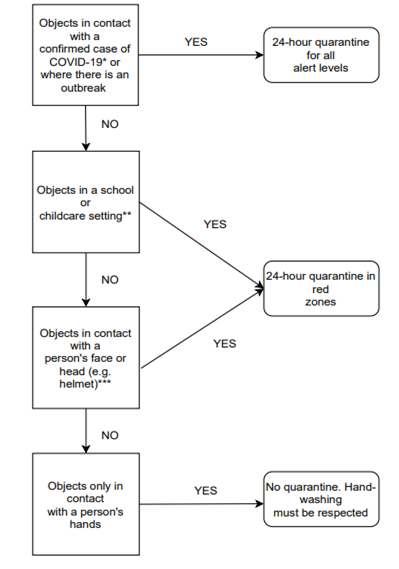
* For objects that have come in contact with a confirmed case of COVID-19, quarantine applies, regardless of whether or not they are shared between groups.
** Lending sports equipment in a childcare or schoolhouse setting could be permitted if a person in accuse can ensure that the children comply with hand-washing instructions before and after handling the equipment.
*** For article of clothing used in fitting rooms in stores, a minimum quarantine period of iii hours could be applied.
Objects touched by a confirmed case of COVID-19 or where there is an outbreak, that cannot be cleaned and disinfected
Objects touched past a confirmed instance of COVID-19 or where there is an outbreak and that cannot exist cleaned and disinfected should be quarantined for a minimum of 24 hours, whatever the alert level for the region. An alternative could be to use a steam cleaner (according to the manufacturer's recommendations, v minutes with 70°C steam and 1 infinitesimal with 100°C steam) (52). For articles of people deceased from COVID-nineteen, meet the INSPQ publication Preventive and Protective Measures for Funeral Services Businesses (88).
Objects in school or childcare environments that cannot be cleaned and disinfected and that are shared between groups
Information technology would exist preferable to continue to utilize a minimum 24-hr quarantine in school and childcare settings in cerise zones, given the challenges of children'due south compliance with hygiene measures, similar hand-washing, as well as the ongoing uncertainty around the role of children in transmitting the infection (89). This quarantine does non utilise to other alarm levels. However, for sports equipment lent out in these settings, given the benefits of practicing sports activities for young people, if a person in charge can supervise the children's hand-washing before and subsequently handling the equipment, the equipment could be lent out without a quarantine, if a quarantine would be too restrictive due to, for example, the quantity of equipment available.
Objects that come in contact with a person's face up or head, that cannot be cleaned and disinfected, and that are shared between groups
For shared objects that come in contact with a person's face or caput, a minimum quarantine of 24 hours should be applied. It seems reasonable to but apply this measure in reddish zones, where community transmission is well established.
Objects that only come up in contact with a person's easily, that cannot exist cleaned and disinfected, and that are shared between groups
For all objects fabricated of whatever non-washable materials and that only come in contact with people'due south hands in an surround in which just adults are present, it could be possible to not employ a quarantine, in any zone. It would then have to exist possible to ensure that good hand hygiene practices are applied at all times.
Glossary
Aerosols: Aerosols are particles suspended in the air, whose movement is mainly governed by their size. They are generally smaller than 100 micrograms (µm) and are potentially inhalable. These particles have been typically called droplets when larger than five µm. They tin be classified co-ordinate to the anatomical site of the airway on which they are deposited:
- Nasopharyngeal particles, which are deposited in the nose or throat (≤ 100 µm)
- Tracheobronchial particles, which are deposited in the bronchi (≤ 15 µm)
- Alveolar particles, which reach the pulmonary alveoli (≤ 5 µm), typically called "microdroplets"
Cultivable: The quality of a virus being able to reproduce itself on appropriate cell cultures under the right conditions. A virus being cultivable does not necessarily hateful that it is infectious.
Surface disinfection: Disinfection done using chemical products to destroy the microorganisms remaining on a surface afterward cleaning, which further reduces the risk of spreading infection (1).
Fomites: Inanimate surfaces and objects.
Surface cleaning: The elimination of dirt and impurities, including microorganisms. Cleaning lone does not impale microorganisms, but partly eliminating them reduces their quantity, and in turn, the gamble of spreading infection (1,2).
Appendix 1 - Methodology brief literature review
- Cautionary note on institutional methodology: YES
- Articulate statement of research question or review objectives: YES
- Documentary inquiry strategy (multiple answers are acceptable):
- COVID-19 scientific monitoring: YES
- Use of targeted institutional COVID-xix scientific monitoring (e.g., CHSLDs): NO
- Use of institutional scientific monitoring of grey literature: Yes
- Specify the type of scientific monitoring (e.thousand., general COVID-19, or prevention/promotion) for a and b, forth with the monitoring period covered for all three : Environmental health scientific monitoring, from August 1 to November xxx, 2022.
- Establish a specific documentary enquiry strategy (retrospective): NO
- Other: Yes.
- Specify: Grey literature research for positions of recognized organizations.
- Use of inclusion criteria: NO
- Apply of preprints
- Indicate their inclusion or exclusion: Yeah
- Facilitated identification of preprints in document: NO
- Data extraction - Inclusion of evidence tables : NO
- Assessment of the quality or standard of bear witness in manufactures or other documents included: NO (Note that such assessment is not essential for this type of rapid response)
- Peer review (listing peer reviewers' names and affiliations on the credits page for b, c, and d) (multiple answers are acceptable)
- by members of the related expert committee: Yeah
- by members of other INSPQ COVID-19 units or committees: YES
- by reviewers inside the INSPQ who did not participate in the project: NO
- by reviewers ouside the INSPQ who did not participate in the project: NO
- no peer review: NO
1 See Health Canada'south listing of approved and safety products for COVID-19 (53).
2 Among the products recommended by Wellness Canada for disinfecting hard surfaces, the ethanol concentration varies from 60% to 80%, while the range for isopropanol is 60% to 75% (53).
three 0.ane% disinfecting bleach solution: add 5 ml (1 teaspoon) of bleach with a 5% base of operations concentration to 250 ml (i cup) of water.
References
- Cleaning and disinfecting public spaces during COVID-xix. Government of Canada. 2022. Available at: https://world wide web.canada.ca/en/public-health/services/publications/diseases-weather condition/cleaning-disinfecting-public-spaces.html
- Cleaning and disinfection of environmental surfaces in the context of COVID-19. Earth Health Organization. 2022. Available at: https://www.who.int/publications-particular/cleaning-and-disinfection-of-environmental-surfaces-inthe-context-of-covid-19
- Ye G, Lin H, Chen L, Wang Due south, Zeng Z, Wang Westward, Zhang S, Rebmann T, Li Y, Pan Z, et al. Ecology contamination of SARS-CoV-2 in healthcare premises. J Infect. 2022 Apr 30;81(2).
- Wu S, Wang Y, Jin X, Tian J, Liu J, Mao, Y. Environmental contamination by SARS-CoV-ii in a designated hospital for coronavirus disease 2022. Am J Infect Control. 2022;x.
- Zhou J, Otter J, Price JR, Cimpeanu C, Garcia DM, Kinross J, Boshier P, Bricklayer S, Commodities F, Holmes AH, et al. (2020). Investigating SARS-CoV-2 surface and air contamination in an astute healthcare setting during the peak of the COVID-nineteen pandemic in London. medRxiv [Online]. 2022. Available at: https://world wide web.medrxiv.org/content/10.1101/2020.05.24.20110346v1
- Ryu B-H, Cho Y, Cho O-H, Hong SI, Kim Due south, Lee S. Ecology contamination of SARS-CoV-2 during the COVID-19 outbreak in South Korea. Am J Infect Control. 2022 May 30;48(eight):875‑9.
- Lei H, Ye F, Liu 10, Huang Z, Ling S, Jiang Z, Cheng, J, Zanin Grand. SARS-CoV-2 ecology contamination associated with persistently infected COVID-19 patients. Influenza Other Respir Viruses. 2022;xiv(6):688‑99.
- Folder RA, Alarja NA, Robie ER, Kochek KE, Xiu L, Rocha-Melogno L, Abdelgadir A, Goli SV, Farrell AS, Coleman KK, et al. Environmental and Aerosolized SARS-CoV-ii Among Hospitalized COVID-xix Patients. J Infect Dis. 2022;222(xi):1798‑806.
- Colaneri K, Seminari E, Novati South, Asperges Due east, Biscarini S, Piralla A, Percivalle East, Cassaniti I, Baldanti F, Bruno R, et al. Severe acute respiratory syndrome coronavirus 2 RNA contamination of inanimate surfaces and virus viability in a health care emergency unit. Clin Microbiol Infect [Online]. 2022 Aug 1;26(8). Bachelor at: https://www.clinicalmicrobiologyandinfection.com/article/S1198-743X(20)30286-X/abstract
- D'Accolti One thousand, Soffritti I, Passaro A, Zuliani G, Antonioli P, Mazzacane S, Manfredini R, Caselli E, et al. SARS-CoV-2 RNA contamination on surfaces of a COVID-19 ward in a hospital of Northern Italy: what risk of transmission? Eur Rev Med Pharmacol Sci. 2022;24(17):9202‑vii.
- Ding Z, Qian H, Xu B, Huang Y, Miao T, Yen H-L, Xiao Southward, Cui L, Wu Ten, Shao W, et al. Toilets dominate ecology detection of severe astute respiratory syndrome coronavirus 2 in a hospital. Sci Total Environ [Online]. 2022 Aug 15;753. Available at: https://world wide web.sciencedirect.com/science/article/abs/pii/S0048969720352396?via%3Dihub
- Kim UJ, Lee SY, Lee JY, Lee A, Kim SE, Choi O-J, Lee JS, Kee S-J, Jang H-C. Air and Environmental Contagion Acquired by COVID-19 Patients: a Multi-Middle Study. J Korean Med Sci [Online]. 2022 Sept 21;35(37). Available at: https://doi.org/x.3346/jkms.2020.35.e332
- Moore K, Rickard H, Stevenson D, Bou PA, Pitman J, Crook A, Davies K, Spencer A, Burton C, Easterbrook L, et al. Detection of SARS-CoV-2 within the healthcare environment: a multicentre written report conducted during the first moving ridge of the COVID-xix outbreak in England. medRxiv [Online]. Common cold Spring Harbor Laboratory Printing. 2022 Sept 25. Available at: https://world wide web.medrxiv.org/content/10.1101/2020.09.24.20191411v1
- Mouchtouri VA, Koureas M, Kyritsi Thou, Vontas A, Kourentis L, Sapounas S, Rigakos Grand, Petinaki East, Tsiodras Due south, Hadjichristodoulou C, et al. Environmental contamination of SARS-CoV-ii on surfaces, air-conditioner and ventilation systems. Int J Hyg Environ Wellness. 2022 Sept one;230:113599.
- Nelson A, Kassimatis J, Estoque J, Yang C, McKee G, Bryce E, Hoang L, Daly P, Lysyshyn M, Hayden As, et al. Ecology detection of astringent acute respiratory syndrome coronavirus ii (SARS-CoV-2) from medical equipment in long-term care facilities undergoing COVID-19 outbreaks. Am J Infect Control. 2022 July vi.
- Pasquarella C, Colucci ME, Bizzarro A, Veronesi L, Affanni P, Meschi T, Brianti E, Vitali P, Albertini R. Detection of SARS-CoV-2 on hospital surfaces. Acta Bio-Medica Atenei Parm. 2022 July xx;91(9-S):76‑viii.
- Peyrony O, Ellouze S, Fontaine J-P, Thegat-Le Cam Yard, Salmona M, Feghoul L, Mahjoub N, Mercier-Delarue S, Gabassi A, Delaugerre C. Surfaces and equipment contamination by severe acute respiratory syndrome coronavirus 2 (SARS-CoV-2) in the emergency department at a university hospital. Int J Hyg Environ Health. Sept 2022;230:113600.
- Razzini K, Castrica Chiliad, Menchetti 50, Maggi Fifty, Negroni Fifty, Orfeo NV, Pizzoccheri A, Stocco M, Muttini Southward, Balzaretti CM. SARS-CoV-two RNA detection in the air and on surfaces in the COVID-xix ward of a hospital in Milan, Italian republic. Sci Total Environ. 2022 November 10;742:140540.
- Santarpia JL, Rivera DN, Herrera VL, Morwitzer MJ, Creager HM, Santarpia GW, Crown KK, Brett-Major DM, Schnaubelt ER, Broadhurst MJ, et al. Droplets and surface contamination of SARS-CoV-ii observed in quarantine and isolation care. Sci Rep. Nature Publishing Group. 2022 July 29;ten(i):12732.
- Tan L, Ma B, Lai X, Han L, Cao P, Zhang J, Fu J, Zhou Q, Wei Due south, Wang Z, et al. Air and surface contamination by SARS-CoV-2 virus in a tertiary hospital in Wuhan, Cathay. Int J Infect Dis [Online]. 2022 July 27;99. Available at: https://www.ijidonline.com/article/S1201-9712(20)30571-3/fulltext
- Wan B, Zhang X, Luo D, Zhang T, Chen 10, Yao Y, Zhao X, Lei 50, Liu C, Zhao West, et al. On-site analysis of COVID-nineteen on the surfaces in wards. Sci Total Environ [Online]. 2022 Aug 18;753. Available at: https://www.sciencedirect.com/scientific discipline/commodity/abs/pii/S0048969720352876?via%3Dihub
- Wei L, Lin J, Duan X, Huang Due west, Lu 10, Zhou J, Zong Z. Asymptomatic COVID-19 Patients Can Contaminate Their Surroundings: an Environment Sampling Study. mSphere [Online]. 2022 June 24;v(3). Available at: https://msphere.asm.org/content/5/3/e00442-20
- Suzuki Grand, Kamiya H, Okamoto Yard, Yamagishi T, Kakimoto K, Takeda M, Matsuyama S, Shirato One thousand, Nao N, Hasegawa H, et al. Environmental sampling for severe acute respiratory syndrome coronavirus two (SARS-CoV-2) during a coronavirus disease (COVID-nineteen) outbreak aboard a commercial cruise ship. medRxiv. 2022 Jan 1. Available at: https://www.medrxiv.org/content/x.1101/2020.05.02.20088567v1
- Döhla 1000, Wilbring 1000, Schulte B, Kümmerer BM, Diegmann C, Sib E, Richter East, Haag A, Englehart South, Eis-Hübinger AM, et al. SARS-CoV-2 in ecology samples of quarantined households. medRxiv [Online]. June 2022. Available at: http://medrxiv.org/lookup/doi/10.1101/2020.05.28.20114041
- Fernández-de-Mera IG, Rodríguez Del-Río FJ, Fuente J de la, Pérez-Sancho M, Hervás D, Moreno I, Domínguez G, Domínguez L, Gortázar C. Detection of environmental SARS-CoV-two RNA in a high prevalence setting in Spain. Transbound Emerg Dis [Online]. 2022 Sept seven. Bachelor at: https://onlinelibrary.wiley.com/doi/10.1111/tbed.13817
- Hu Ten, Xing Y, Ni W, Zhang F, Lu S, Wang Z, Gao R, Jiang F. Environmental contagion past SARS-CoV-2 of an imported case during incubation menstruum. Sci Total Environ [Online]. 2022 Nov 10;742. Available at: http://www.sciencedirect.com/science/article/pii/S0048969720341425
- Jiang F-C, Jiang X-L, Wang Z-M, Meng Z-H, Shao S-F, Anderson BD, Ma M-J. Detection of Severe Astute Respiratory Syndrome Coronavirus 2 RNA on Surfaces in Quarantine Rooms. Emerg Infect Dis J [Online]. Sept 2022;26(nine). Bachelor at: https://wwwnc.cdc.gov/eid/commodity/26/9/20-1435_article
- Luo 50, Liu D, Zhang H, Li Z, Zhen R, Zhang X, Xie H, Song W, Liu J, Huang Q, et al. Air and surface contamination in non-health care settings amidst 641 environmental specimens of 39 COVID-19 cases. PLoS Negl Trop Dis [Online]. 2022 Oct 9;14(10). Bachelor at: https://journals.plos.org/plosntds/commodity?id=ten.1371/journal.pntd.0008570
- Ong SWX, Lee PH, Tan YK, Ling LM, Ho BCH, Ng CG, Wang DL, Tan BH, Leo Y-S, Ng O-T, et al. Ecology contamination in a COVID-xix intensive care unit–What is the risk? Infect Command Hosp Epidemiol. 2022;1‑9.
- van Doremalen N, Bushmaker T, Morris DH, Holbrook MG, Gamble A, Williamson BN, Tamin A, Harcourt JL, Thornburg NJ, Gerber SI, et al. Aerosol and Surface Stability of SARS-CoV-ii as Compared with SARS-CoV-1. N Engl J Med [Online]. 2022. Available at: http://www.nejm.org/doi/10.1056/NEJMc2004973
- Chin AWH, Chu JTS, Perera MRA, Hui KPY, Yen H-Fifty, Chan MCW, Peiris 1000, Poon LLM. Stability of SARS-CoV-2 in unlike environmental conditions. Lancet Microbe [Online]. 2022;i(i). Available at: http://www.sciencedirect.com/science/commodity/pii/S2666524720300033
- Harbourt D, Haddow A, Piper A, Bloomfield H, Kearney B, Gibson K, Minogue T. Modeling the Stability of Astringent Astute Respiratory Syndrome Coronavirus 2 (SARS-CoV-2) on Skin, Currency, and Clothing. medRxiv [Online]. Cold Spring Harbor Laboratory Press. 2022 July 3. Available at: https://www.medrxiv.org/content/10.1101/2020.07.01.20144253v1
- Liu Y, Li T, Deng Y, Liu S, Zhang D, Li H, Wang X, Jia Fifty, Han J, Bei Z, et al. Stability of SARS-CoV-2 on environmental surfaces and in human excreta. J Hosp Infect [Online]. 2022 Nov 1. Bachelor at: http://www.sciencedirect.com/science/article/pii/S0195670120305041
- Comité santé environnementale de COVID-19. COVID-nineteen: Outdoor environment. Institut national de santé publique du Québec. May 2022. Bachelor at: https://world wide web.inspq.qc.ca/en/publications/3002-outdoor-environment-covid19
- Schuit Chiliad, Ratnesar-Shumate S, Yolitz J, Williams G, Weaver Westward, Greenish B, Miller D, Krause M, Beck Grand, Wood South, et al. Airborne SARS-CoV-2 is Quickly Inactivated by Simulated Sunlight. J Infect Dis. 2022 June eleven;222(iv):564‑71.
- Heilingloh CS, Aufderhorst UW, Schipper 50, Dittmer U, Witzke O, Yang D, Zheng 10, Sutter K, Trilling M, Alt M, et al. Susceptibility of SARS-CoV-2 to UV irradiation. Am J Infect Control. Elsevier. 2022 Oct 4;48(10):1273‑five.
- Brlek A, Vidović Š, Vuzem S, Turk Chiliad, Simonović Z. Possible indirect manual of COVID-nineteen at a squash court, Slovenia, March 2022: example study. Epidemiol Infect [Online]. 2022 June 19;148. Available at: https://world wide web.ncbi.nlm.nih.gov/pmc/articles/PMC7327185/
- Cai J, Sun W, Huang J, Gamber One thousand, Wu J, He G. Early Release - Indirect Virus Manual in Cluster of COVID-xix Cases, Wenzhou, China, 2022. Emerg Infect Dis J [Online]. 2022;26(6). Bachelor at: https://wwwnc.cdc.gov/eid/article/26/6/20-0412_article
- Xie C, Zhao H, Li K, Zhang Z, Lu 10, Peng H, Wang D, CHen J, Zhang X, Wu D, Gu Y. The evidence of indirect transmission of SARS-CoV-2 reported in Guangzhou, China. BMC Public Health. 2022 Aug five;20(1):1202.
- COVID-nineteen Transmission in Condo or Apartment Buildings Rapid Review. Alberta Wellness Services. 2022. Bachelor at: https://www.albertahealthservices.ca/assets/info/ppih/if-ppih-covid-19-sag-transmission-in-condo-or-apartment-buildings-rapid-review.pdf
- Pung R, Chiew CJ, Young BE, Chin S, Chen MI-C, Clapham HE, Melt AR, Maurer-Stroh S, Toh MPHS, Poh C et al. Investigation of three clusters of COVID-xix in Singapore: implications for surveillance and response measures. The Lancet. 2022 Mar 28;395(10229):1039‑46.
- Sia SF, Yan Fifty-M, Chin AWH, Fung K, Choy K-T, Wong AYL, Kaewpreedee, P, Perera RAPM, Poon LLM, Nicholls JM, et al. Pathogenesis and transmission of SARS-CoV-2 in golden hamsters. Nature. July 2022;583(7818):834‑8.
- Brurberg, KG. Transmission of SARS-CoV-2 via contact and droplets, 1st update – a rapid review. Norwegian Institute of Public Health. 2022. Available at: https://www.fhi.no/en/publ/2020/Transmission-of-SARS-CoV-2-via-contact-and-aerosol-1st-updat-/
- COVID-19 Routes of Transmission – What Nosotros Know So Far. Public Health Ontario. 2022. Bachelor at: https://www.publichealthontario.ca/-/media/documents/ncov/wwksf-routes-manual-mar-06-2020.pdf?la=en
- Manual of SARS-CoV-2: implications for infection prevention precautions. World Health Organization. 2022. Available at: https://world wide web.who.int/news-room/commentaries/detail/transmission-of-sars-cov-ii-implications-for-infection-prevention-precautions
- Dietz L, Horve PF, Whorl DA, Fretz M, Eisen JA, Wymelenberg KVD. 2022 Novel Coronavirus (COVID-19) Pandemic: Congenital Environment Considerations To Reduce Manual. mSystems [Online]. 2022 Apr 28;5(ii). Available at: https://msystems.asm.org/content/5/two/e00245-20
- Kampf, Brüggemann Y, Kaba HEJ, Steinmann J, Pfaender S, Scheithauer S, Steinmann East. Potential sources, modes of transmission and effectiveness of prevention measures against SARS-CoV-2. J Hosp Infect [Online]. 2022 Sept eighteen. Available at: https://world wide web.journalofhospitalinfection.com/article/S0195-6701(twenty)30437-0/abstruse
- Kanamori H, Weber DJ, Rutala WA. The role of the healthcare surface environment in SARS-CoV-2 transmission and potential control measures. Clin Infect Dis [Online]. 2022. Available at: https://bookish.oup.com/cid/advance-article/doi/10.1093/cid/ciaa1467/5912347
- Karia R, Gupta I, Khandait H, Yadav A, Yadav A. COVID-19 and its Modes of Transmission. SN Compr Clin Med. 2022 Sept 1;1‑4.
- Vella F, Senia P, Ceccarelli Grand, Vitale E, Maltezou H, Taibi R, Lleshi A, Venanzi Rullo E, Pellicanò GF, Rapisarda Five, et al. Transmission manner associated with coronavirus affliction 2022: a review. Eur Rev Med Pharmacol Sci. July 2022;24(14):7889‑904.
- How COVID-19 Spreads. Centers for Disease Command and Prevention. U.Southward. Department of Wellness and Human Services. 2022. Bachelor at: https://world wide web.cdc.gov/coronavirus/2019-ncov/prevent-getting-ill/how-covid-spreads.html
- COVID-19: cleaning in non-healthcare settings exterior the home. Public Wellness England. Government of the United Kingdom. October 2022. Available at: https://world wide web.gov.britain/government/publications/covid-xix-decontamination-in-non-healthcare-settings
- Hard-surface disinfectants and hand sanitizers (COVID-xix). 2022. Health Canada. Government of Canada. Available at: https://www.canada.ca/fr/sante-canada/services/medicaments-produits-sante/desinfectants/covid-19.html
- Expedited access to disinfectants, hand sanitizers and personal protective equipment to help limit the spread of COVID-19, likewise equally swabs for testing. Health Canada. Authorities of Canada. 2022. Available at: https://healthycanadians.gc.ca/remember-alert-rappel-avis/hc-sc/2020/72623a-eng.php
- Coronavirus Affliction 2022 (COVID-19) Cleaning and Disinfection for Public Settings. Public Wellness Ontario. 2022. Bachelor at: https://www.publichealthontario.ca/-/media/documents/ncov/factsheet-covid-19-environmental-cleaning.pdf?la=fr
- Cleaning and Disinfecting Your Dwelling house: Every Day and When Someone is Sick. Centers for Disease Control and Prevention. 2022. Available at: https://world wide web.cdc.gov/coronavirus/2019-ncov/forbid-getting-sick/disinfecting-your-dwelling.html
- Increases in exposure calls related to selected cleaners and disinfectants at the onset of the COVID-xix pandemic: information from Canadian toxicant centres. Public Wellness Agency of Canada. Authorities of Canada. 2022. Available at: https://world wide web.canada.ca/en/public-wellness/services/reports-publications/wellness-promotion-chronic-disease-prevention-canada-research-policy-practise/vol-41-no-1-2021/exposure-cleaners-disinfectants-covid-19-pandemic-canadian-poison-centres.html
- Chang A, Schnall AH, Law R, Bronstein AC, Marraffa JM, Spiller HA, Hays HL, Funk AR, Mercurio-Zappala M, Calello DP, et al.. Cleaning and Disinfectant Chemic Exposures and Temporal Associations with COVID-19 — National Poison Data System, Usa, January 1, 2022–March 31, 2022. MMWR Morb Mortal Wkly Rep [Online]. 2022;69(xvi):496-viii. Bachelor at: https://www.cdc.gov/mmwr/volumes/69/wr/mm6916e1.htm
- Gharpure R, Hunter CM, Schnall AH, Barrett CE, Kirby AE, Kunz J, Berling Grand, Mercante JW, Murphy JL, Garcia-Williams AG. Cognition and Practices Regarding Safe Household Cleaning and Disinfection for COVID-19 Prevention — United States, May 2022. MMWR Morb Mortal Wkly Rep [Online]. 2022;69(23);705-9. Available at: https://www.cdc.gov/mmwr/volumes/69/wr/mm6923e2.htm
- A Rapid Review of Disinfectant Chemical Exposures and Health Furnishings During COVID-19 Pandemic. National Collaborating Centre for Environmental Wellness. Oct 2022. Bachelor at: https://ncceh.ca/documents/field-inquiry/rapid-review-disinfectant-chemic-exposures-and-health-effects-during
- Folletti I, Zock J-P, Moscato G, Siracusa A. Asthma and rhinitis in cleaning workers: a systematic review of epidemiological studies. J Asthma Off J Assoc Care Asthma. Feb 2022;51(1):18‑28.
- Zock J-P, Plana E, Jarvis D, Antó JM, Kromhout H, Kennedy SM, Künzli N, Villani Southward, Olivieri Chiliad, Torén K, et al. The utilise of household cleaning sprays and adult asthma: an international longitudinal written report. Am J Respir Crit Care Med. 2007 Oct 15;176(8):735‑41.
- Moual NL, Varraso R, Siroux V, Dumas O, Nadif R, Pin I, Zock J-P, Kauffmann F. Domestic apply of cleaning sprays and asthma activity in females. Eur Respir J. 2022 Dec i;twoscore(6):1381‑9.
- Cleaning Your Facility: Every Twenty-four hour period and When Someone is Sick. Centers for Disease Control and Prevention. 2022. Available at: https://www.cdc.gov/coronavirus/2019-ncov/community/reopen-guidance.html
- COVID-19 Public Health Recommendations for Environmental Cleaning of Public Facilities. Alberta Wellness Services. 2022. Available at: https://world wide web.albertahealthservices.ca/assets/info/ppih/if-ppih-covid-nineteen-environmental-cleaning-public-facilities.pdf
- Cleaning for COVID-nineteen - advice for sectors outside the healthcare service. Norwegian Institute of Public Health. 2022. Available at: https://www.fhi.no/en/op/novel-coronavirus-facts-advice/advice-and-information-to-other-sectors-and-occupational-groups/cleaning-and-disinfection/
- Pratiques de base - Entretien, hygiène et salubrité des objets, des surfaces et des locaux. In: Prévention et contrôle des infections dans les services de garde et écoles du Québec - Guide d'intervention. Ministère de la Santé et des Services sociaux. Gouvernement du Québec. 2022. p. 53‑69. Available at: https://publications.msss.gouv.qc.ca/msss/fichiers/guide-garderie/chap4-entretien-hygiene.pdf
- Cleaning Guidelines for the Prevention of COVID-xix Infections. Finnish Institute of Occupational Wellness. 2022. Available at: https://www.ttl.fi/en/cleaning-guidelines-for-the-prevention-of-covid-xix-infections
- Individual and customs-based measures to mitigate the spread of COVID-xix in Canada. Government of Canada. 2022. Available at: https://www.canada.ca/en/public-health/services/diseases/2019-novel-coro...
- Cleaning and Disinfecting: Best Practices During the COVID-xix Pandemic. United States Ecology Protection Bureau. 2022. Bachelor at: https://world wide web.epa.gov/coronavirus/cleaning-and-disinfecting-best-practices-during-covid-19-pandemic
- Middle for Nutrient Security and Public Health. Disinfection 101. Iowa State University. May 2008. Available at: http://www.cfsph.iastate.edu/Disinfection/Assets/Disinfection101.pdf
- Kampf 1000, Todt D, Pfaender S, Steinmann E. Persistence of coronaviruses on inanimate surfaces and their inactivation with biocidal agents. J Hosp Infect. 2022;104(3):246‑51.
- SAT-COVID-19 Working Group. Services de garde en installation : Mesures de prévention de la COVID-19 en milieu de travail - Recommandations intérimaires. Institut national de santé publique du Québec. Aug 2022. Available at: https://www.inspq.qc.ca/sites/default/files/covid/2984-travailleuses-services-garde-covid19.pdf
- Coronavirus SARS-CoV-2 : nettoyage et désinfection des établissements recevant du public et des lieux de travail. Haut Conseil de la santé publique. 2022. Available at: https://www.hcsp.fr/explore.cgi/avisrapportsdomaine?clefr=811
- Quirce S, Barranco P. Cleaning agents and asthma. J Investig Allergol Clin Immunol. 2022;20(7):542‑50.
- Sat-COVID-19 Working Group. COVID-19: Hierarchy of Control Measures in the Workplace - Preventive Measures in the Workplace. Institut national de santé publique du Québec. 2022. Bachelor at: https://world wide web.inspq.qc.ca/en/publications/3022-hierarchy-control-measures-workplace-covid19
- Sabbatum-COVID-xix Working Group. Schools and teaching environments - COVID-19 Preventive Measures in the Workplace. Institut national de santé publique du Québec. 2022. Available at: https://www.inspq.qc.ca/en/publications/3056-schools-and-pedagogy-environments-covid19
- Anctil Grand, Caron S, Charest J, Irace-Cima A, Gilca 5, Sauvageau C, Villeneuve j, Huot C, Lévesque B, Perron S. Manual du SRAS-CoV-2 : constats et proposition de terminologie. Institut national de santé publique du Québec. 2022. Available at: https://world wide web.inspq.qc.ca/publications/3099-transmission-sras-cov-two-constats-terminologie-covid19
- Fears Air conditioning, Klimstra WB, Duprex P, Hartman A, Weaver SC, Plante KS, Mirchandani D, Plante JA, Aguilar PV, Fernández D, et al. Persistence of Severe Acute Respiratory Syndrome Coronavirus two in Aerosol Suspensions. Emerg Infect Dis J [Online]. 2022;26(9). Available at: https://wwwnc.cdc.gov/eid/article/26/9/xx-1806_article
- Scientific Cursory: SARS-CoV-ii Transmission. Centers for Disease Control and Prevention. 2022. Available at: https://www.cdc.gov/coronavirus/2019-ncov/science/science-briefs/sars-cov-ii-transmission.html
- Tin I use fogging, fumigation, or electrostatic spraying or drones to aid command COVID-19? United States Environmental Protection Agency. United States government, 2022. Available at: https://www.epa.gov/coronavirus/can-i-use-fogging-fumigation-or-electrostatic-spraying-or-drones-assist-control-covid-19
- COVID-19 in indoor environments — Air and surface disinfection measures. National Collaborating Centre for Environmental Health. 2022. Bachelor at: https://ncceh.ca/documents/guide/covid-19-indoor-environments-air-and-surface-disinfection-measures
- Guide de normes sanitaires en milieu de travail pour le secteur des activités intérieures et extérieures de sport, de loisir et de plein air – COVID-19 – La SST, c'est l'affaire de tous! Commission des normes, de l'équité, de la santé et de la sécurité du travail. Gouvernement du Québec.2020. Available at: https://www.cnesst.gouv.qc.ca/sites/default/files/documents/dc100-2161-guide-sports-loisirs_0.pdf
- Guidelines specific to recreation and sports. Gouvernement du Québec. 2022. Available at: https://www.quebec.ca/en/tourism-and-recreation/sporting-and-outdoor-activities/resumption-outdoor-recreational-sports-leisure-activities
- Reducing COVID-19 gamble in community settings: A tool for operators. Regime of Canada. 2022. Available at: https://world wide web.canada.ca/en/public-health/services/diseases/2019-novel-coronavirus-infection/guidance-documents/gamble-mitigation-tool-outdoor-recreation-spaces-activities-operating-covid-19.html
- Huppé Five, Huot C. Lieux de baignade. Institut national de santé publique du Québec. 2022. Available at: https://world wide web.inspq.qc.ca/publications/3004-lieux-baignade-qr-covid19
- Guidance for Cleaning and Disinfecting Public Spaces, Workplaces, Businesses, Schools, and Homes. The states authorities. United States Environmental Protection Agency and Centers for Disease Control and Prevention. Apr 2022. Available at: https://www.epa.gov/sites/production/files/2020-04/documents/316485-c_reopeningamerica_guidance_4.19_6pm.pdf
- Côté R, Roy L-A, Valiquette Fifty. COVID-19: Preventive and Protective Measures for Funeral Services Businesses. Institut national de santé publique du Québec. July 2022. Available at: https://www.inspq.qc.ca/sites/default/files/publications/2913-funeral-services-businesses-covid19.pdf
- Comité sur les mesures populationnelles. Revue rapide de la littérature scientifique et données épidémiologiques provinciales de la COVID-19 parmi les jeunes âgés de moins de 18 ans. Institut national de santé publique du Québec. Dec 2022. Available at: https://world wide web.inspq.qc.ca/sites/default/files/covid/3007-enfants-risques-infections-transmission-covid19.pdf
AUTHOR
Caroline Huot, Public Wellness Medical Specialist
Comité en santé environnementale COVID-nineteen [COVID-nineteen Environmental Health Committee]
Management de la santé environnementale et de la toxicologie
CONTRIBUTORS
Stéphane Perron, Public Health Medical Specialist
Stéphanie Potvin, Scientific Advisor
Comité en santé environnementale COVID-nineteen [COVID-19 Environmental Wellness Committee]
Management de la santé environnementale et de la toxicologie
REVIEWERS
Stéphane Caron, Medical Advisor
COVID-xix Working Group
Direction des risques biologiques et de la santé au travail of the INSPQ
Geneviève Anctil, Nursing Advisor
Jasmin Villeneuve, Medical Advisor
Chantal Richard, Nursing Counselor
Comité prévention et contrôle des infections [Infection Prevention and Command Committee]
Direction des risques biologiques et de la santé au travail

Source: https://www.inspq.qc.ca/en/publications/3054-surface-cleaning-disinfection-covid19
Posted by: marleyearost.blogspot.com
0 Response to "Why Is It Important For Our Experiment That The Surfaces Be Clean And Dry?"
Post a Comment