

Should I Clean The Blade Of A 1907 Wilkinson Bayonet
| Sword bayonet, Pattern 1907 | |
|---|---|
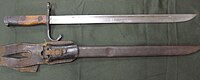
 Pattern 1907 bayonet with scabbard. | |
| Type | Bayonet |
| Identify of origin | United Kingdom |
| Service history | |
| In service | 20th century |
| Used by | British Empire |
| Wars | World War I World War II |
| Production history | |
| Designed | 1906–1907 |
| Manufacturer | James A. Chapman, Robert Mole & Sons, Sanderson Bros & Newbould Ltd, Vickers Ltd and Wilkinson Sword |
| Produced | 1908–1945 |
| No. built | More than 5,000,000 |
| Specifications | |
| Mass | 16+ 1⁄two oz (470 1000) |
| Length | 21+ 3⁄4 in (550 mm) |
| Bract length | 17 in (430 mm) |
| References | Australian War Memorial[1] and Ballard & Bennett[2] |
The Pattern 1907 bayonet, officially called the Sword bayonet, pattern 1907 (Mark I), was a British bayonet designed to exist used with the Short Mag Lee Enfield (SMLE) rifle. The Blueprint 1907 bayonet was used by the British and Republic forces throughout both the First and 2nd Earth Wars.
Blueprint [edit]
The Pattern 1907 bayonet consisted of a i-piece steel bract and tang, with a crossguard and pommel fabricated from wrought iron or balmy steel, and a wooden grip unremarkably of walnut secured to the tang past ii screws. The entire bayonet was 21+ iii⁄4 inches (550 mm) long and weighed xvi+ 1⁄ii ounces (470 thousand), although the weight of production models varied from 16 to 18 ounces (450 to 510 g). Originally the bayonet featured a hooked lower quillion intended for trapping an enemy'due south bayonet and perhaps disarming opponents when grappling. This was later deemed impractical and replaced with a simpler pattern from 1913. Often unit armourers subsequently removed the hooked quillion when the bayonet was sent for repair, although there is no evidence that this was officially directed.[two] [iii]
The Design 1907 bayonet's blade was 17 inches (430 mm) long. A shallow fuller was machined into both sides of the bract, 12 inches (300 mm) long and extending to within 3 inches (76 mm) of the tip, with variations due to the judgement of individual machinists.[ii] [3]

Original hooked quillion of the Pattern 1907 bayonet.
The Pattern 1907 bayonet was supplied with a elementary leather scabbard flitted with a steel pinnacle-mountain and chape, and usually carried from the belt by a simple frog. The Pattern 1907 bayonet attached to the SMLE by a boss located beneath the barrel on the nose of the burglarize and a mortise groove on the pommel of the bayonet.[2] [4]
The combined length of the SMLE and Pattern 1907 bayonet was 5 feet 2 inches (1.57 1000).[ii]
Markings [edit]

Pattern 1907 bayonet fitted to SMLE burglarize.
Official marks were stamped onto the Pattern 1907 bayonet's ricasso. On British manufactured bayonets the right side included an '10' bend-test mark, a wide arrow government acceptance marking, and one or more Royal Minor Arms Manufactory appointed inspector's marks, on the left side was the engagement of the bayonet's official inspection and the maker's name and the reigning monarch'southward crown and royal cypher, 'ER' (Edward Rex) or later 1910 'GR' (George King).[2] [v]
Indian bayonets were marked similarly to British bayonets except the regal cypher read 'GRI' (George Male monarch Imperator) and the manufacturer's mark was 'R.F.I.' (Rifle Manufactory Ishapore). Australian bayonets differed in the manufacturer's marks, with 'Lithgow' (Lithgow Small Artillery Manufactory), 'MA' (Mangrovite Armory) and 'OA' (Orange Arsenal). The wooden grips of Globe War II era Australian bayonets were oft marked 'SLAZ' for Slazenger, who made the grips during that war.[five]
History [edit]
When the British military adopted the Curt Magazine Lee-Enfield rifle, its barrel was shortened to 25.two inches (640 mm), 5 inches (130 mm) shorter than the preceding Magazine Lee-Enfield. British war machine strategists were fearful that the British infantry would be at a disadvantage when engaged in a bayonet duel with enemy soldiers who retained a longer achieve. Bayonet fighting drills formed a significant office of a contemporary British infantryman's training. Soldiers were drilled in various stances and parrying techniques against an enemy also armed with rifle and bayonet. The combined length of the SMLE and the in-service Pattern 1903 bayonet, which had a 12-inch (300 mm) blade, was 4 feet nine inches (1.45 m), shorter than the gimmicky French Lebel Model 1886 at 6 anxiety (one.eight m) and the German language Mauser 1898 at 5 feet x inches (1.77 m).[ii] [4]
Japanese Ariska, Type 30 bayonet.
In 1906–seven the British Army conducted trials to find a new longer standard issue bayonet. Experiments were conducted with a number of strange bayonet designs, including a modified version of the American Model 1905 bayonet and the Japanese Blazon xxx bayonet. The trials resulted in the British Army adopting its own version of the Type thirty bayonet. The new design was designated Sword bayonet, design 1907 (Mark I) and was officially introduced on 30 January 1908.[1] [ii] [five] [6]
Approximately 5,000,000 Blueprint 1907 bayonets were made in Britain during World War I. The makers were Wilkinson Sword, Sanderson Brothers & Newbould Ltd, James A. Chapman, Robert Mole & Sons, and Vickers Ltd. Additionally, Remington UMC produced approximately 100,000 during the state of war. The Pattern 1907 bayonet was manufactured in India from 1911 to 1940 at the Rifle Manufacturing plant Ishapore and in Commonwealth of australia from 1913 to 1927, and then again between 1940 and 1945 at the Lithgow Small Arms Factory.[5]
The Pattern 1907 bayonet was adopted by most of the British Commonwealth along with the SMLE. It saw broad front line service until 1945, seeing service in both Earth War I and World War II. Information technology remained in Australian and Indian service for some time subsequently 1945.[5] [seven]
In 1926 the 1907 bayonet was reclassified as the 'Bayonet, No.one, Mk.1'
Variants [edit]
Pattern 1913 bayonet [edit]
The Design 1913 bayonet was designed to exist used with the experimental Pattern 1913 Enfield. The Pattern 1913 bayonet's only functional divergence from the Design 1907 bayonet was a longer cross baby-sit for the muzzle band, to fit the Pattern 1913 Enfield rifle. Upon the outbreak of Globe War I the British authorities adjusted the Pattern 1913 Enfield to the .303 British cartridge, creating the Pattern 1914 Enfield rifle, and contracts were awarded to the United States arms manufacturers Winchester, Remington and Eddystone for the burglarize's production. To accompany those rifles, Remington manufactured the 1,243,000 Pattern 1913 bayonets and Winchester produced 225,000.[5] [viii] [9] [10]
The Pattern 1917 bayonet cannot be fixed to the Lee-Enfield rifle (because of the different cage ring heights), then to avoid confusion with the Pattern 1907 bayonet, two deep vertical grooves were cut into the wooden grips of the Pattern 1913 bayonet.[five] [9]
Model 1917 bayonet [edit]
Upon their entry into Earth State of war I, the United States armed services adapted the Blueprint 1914 Enfield rifle to the .xxx-06 Springfield cartridge to make up for shortfalls in production of the Model 1903 Springfield rifles, creating the substitute standard Model 1917 Enfield rifle. To accompany the M1917 rifle, the Us simply adopted the Blueprint 1913 bayonet every bit the Model 1917 bayonet. Over two,000,000 Model 1917 bayonets were manufactured in the United states during the war, including 545,000 Blueprint 1913 bayonets manufactured for but not delivered to the British armed services, that were but re-stamped as Model 1917 bayonets. The Model 1917 bayonet was adopted unchanged to be used with U.s. Army gainsay shotguns. After the war, the M1917 bayonet was retained for use with gainsay shotguns, and remained in United States service until the 1980s.[v] [10] [11]
India Pattern bayonets [edit]
From 1941, India began cutting downwards Pattern 1907 bayonets to 12.2 in (310 mm) and grinding a point into the remaining blade, creating the India Blueprint No. 1 Mk. I*. The India Pattern No. one Mk. I** is almost identical except a false edge 2 in (51 mm) long is ground into the pinnacle of the blade. Both were recognisable by the fuller, which now ran the length of the blade. The India Blueprint No. 1 Mk. Ii and the India Pattern No. 1 Mk. Ii* were newly manufactured versions with 12.2 inch blades that had no fuller, the latter having a fake edge on elevation side. Both retained the Design 1907 hilt and grip. The Bharat Design No. 1 Mk. III and the India Pattern No. 1 Mk. Iii* were like to the No. 1 Mk. II and No. 1 Mk. Two* except they had crude squared pommels and rectangular grips, and were finished with black paint.[v]
Run into also [edit]
- Sword bayonet
References [edit]
- ^ a b Australian State of war Memorial, "Pattern 07 Bayonet and Scabbard", awm.gov.au Archived ix Feb 2022 at the Wayback Machine, retrieved 5 February 2022.
- ^ a b c d east f g h John Thou. Ballard & Julian Bennett, "An Investigation of the Weights of Pattern 1907 Bayonets made in the Britain around the Commencement World State of war Period" Archived 9 February 2022 at the Wayback Automobile, Arms & Armour, Volume 14, Issue 2, 2022.
- ^ a b Chris McNab, The globe'south greatest small arms: an illustrated history, London, Amber Books Ltd, 2022, ISBN 9781782742746.
- ^ a b Peter Doyle & Chris Foster, What Tommy took to war: 1914–1918, London: Bloomsbury Publishing, 2022, ISBN 9780747814771.
- ^ a b c d e f g h i Ralf Cobb, "Bayonets for the Curt, Magazine, Lee-Enfield rifles", worldbayonets.com Archived 12 November 2022 at the Wayback Machine, retrieved vii Feb 2022.
- ^ Majestic Armouries, "1907 pattern bayonet", royalarmouries.org Archived xiii Oct 2022 at the Wayback Machine, retrieved five February 2022.
- ^ Imperial War Museum, "Sword Bayonet, Pattern 1907, with scabbard", iwm.org.uk Archived nine Feb 2022 at the Wayback Machine, retrieved 5 February 2022.
- ^ Australian State of war Memorial, "Pattern 1917 Sword Bayonet and Scabbard", awm.gov.au, retrieved 7 February 2022.
- ^ a b Purple War Museum, "Sword Bayonet for The states produced .303 calibre Enfield Pattern 1914 burglarize & Pattern 1913 (2nd blazon, US production)", iwm.org.uk Archived 9 February 2022 at the Wayback Machine, retrieved 7 February 2022.
- ^ a b Gary Cunningham, "Collecting the US Bayonet, Model 1917", usmilitaryknives.com Archived 30 January 2022 at the Wayback Machine, retrieved 7 February 2022.
- ^ Gordon 50. Rottman, World State of war II United states of america Army combat equipments, London: Bloomsbury Publishing, 2022, ISBN 9781472814258.

Source: https://en.wikipedia.org/wiki/Pattern_1907_bayonet
Posted by: marleyearost.blogspot.com
0 Response to "Should I Clean The Blade Of A 1907 Wilkinson Bayonet"
Post a Comment