

Do They Use Maggots To Clean Wounds
| Maggot therapy | |
|---|---|
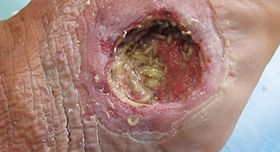 Maggot debridement therapy on a wound from a diabetic foot | |
| Other names | maggot debridement therapy (MDT), larval therapy, larva therapy, larvae therapy, biodebridement, biosurgery |
Maggot therapy (also known as larval therapy) is a type of biotherapy involving the introduction of live, disinfected maggots (fly larvae) into non-healing skin and soft-tissue wounds of a human or other animal for the purpose of cleaning out the necrotic (dead) tissue within a wound, (debridement) and disinfection.
There is evidence that maggot therapy may help with wound healing.[1] [ii]
Medical uses [edit]
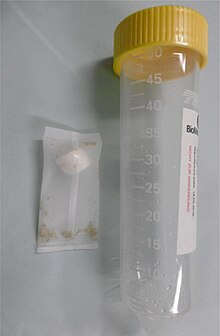
Maggots in medical packaging
Maggot therapy improves healing in chronic ulcers.[1] In diabetic foot ulcers there is tentative evidence of benefit.[iii] A Cochrane review of methods for the debridement of venous leg ulcers found maggot therapy to be broadly equally effective as most other methods, but the study too noted that the quality of data was poor.[four]
In 2004, the United States Nutrient and Drug Administration (FDA) cleared maggots from common green canteen fly for utilize every bit a "medical device" in the The states for the purpose of treatment of:[5]
- Non-healing necrotic pare and soft tissue wounds
- Pressure level ulcers
- Venous stasis ulcers
- Neuropathic foot ulcers
- Non-healing traumatic or post-surgical wounds
Limitations [edit]
The wound must be of a type that can benefit from the application of maggot therapy. A moist, exudating wound with sufficient oxygen supply is a prerequisite. Not all wound-types are suitable: wounds which are dry, or open up wounds of body cavities do not provide a good environment for maggots to feed. In some cases it may be possible to make a dry out wound suitable for larval therapy by moistening it with saline soaks.[6]
Patients and doctors may observe maggots distasteful, although studies accept shown that this does non cause patients to refuse the offering of maggot therapy.[7] Maggots tin can be enclosed in opaque polymer numberless to hide them from sight. Dressings must be designed to prevent any maggots from escaping, while allowing air to get to the maggots.[8] Dressings are too designed to minimize the uncomfortable tickling sensation that the maggots ofttimes cause.[nine]
Mechanisms of action [edit]
The maggots accept 4 main actions:
- Debridement[10]
- Disinfection of the wound[eleven]
- Stimulation of healing[11]
- Biofilm inhibition and eradication[12]
Debridement [edit]
In maggot therapy, big numbers of small maggots eat necrotic tissue far more precisely than is possible in a normal surgical operation, and can debride a wound in a mean solar day or two. The expanse of a wound'southward surface is typically increased with the use of maggots due to the undebrided surface not revealing the bodily underlying size of the wound. They derive nutrients through a process known equally "extracorporeal digestion" by secreting a broad spectrum of proteolytic enzymes[13] that liquefy necrotic tissue, and blot the semi-liquid result within a few days. In an optimum wound environs maggots molt twice, increasing in length from nearly ii mm to near x mm, and in girth, within a period of 48–72 hours by ingesting necrotic tissue, leaving a clean wound costless of necrotic tissue when they are removed.[14]
Disinfection [edit]
Secretions from maggots believed to accept broad-spectrum antimicrobial activity include allantoin, urea, phenylacetic acid, phenylacetaldehyde, calcium carbonate, proteolytic enzymes, and many others.[15] In vitro studies have shown that maggots inhibit and destroy a wide range of pathogenic bacteria including methicillin-resistant Staphylococcus aureus (MRSA), group A and B streptococci, and Gram-positive aerobic and anaerobic strains.[sixteen] Other bacteria like Pseudomonas aeruginosa, Eastward. coli or Proteus spp. are not attacked by maggots, and in case of Pseudomonas even the maggots are in danger.[17]
Biology of maggots [edit]


Those flies whose larvae feed on dead animals will sometimes lay their eggs on the dead parts (necrotic or gangrenous tissue) of living animals. The infestation by maggots of live animals is called myiasis. Some maggots will feed only on expressionless tissue, some only on alive tissue, and some on live or dead tissue. The flies used most often for the purpose of maggot therapy are blow flies of the Calliphoridae: the blow wing species used near commonly is Lucilia sericata, the common green canteen fly. Some other of import species, Protophormia terraenovae, is also notable for its feeding secretions, which combat infection by Streptococcus pyogenes and Due south. pneumoniae.[eighteen]
History [edit]
Written records take documented that maggots have been used since artifact equally a wound handling.[19] There are reports of the utilize of maggots for wound healing past Maya, Native Americans, and Ancient tribes in Australia. Maggot handling was reported in Renaissance times. Military physicians observed that soldiers whose wounds had become colonized with maggots experienced significantly less morbidity and mortality than soldiers whose wounds had not become colonized. These physicians included Napoleon's general surgeon, Businesswoman Dominique Larrey. Larrey reported during France'southward Egyptian campaign in Syria (1798–1801) that sure species of fly consumed only dead tissue and helped wounds to heal.[18]
Joseph Jones, a ranking Confederate medical officeholder during the American Ceremonious War, stated:
I have frequently seen neglected wounds ... filled with maggots ... equally far as my experience extends, these worms eat only dead tissues, and do not hurt specifically the well parts."
The first documented therapeutic employ of maggots in the United States is credited to a second Confederate medical officeholder Dr. J.F. Zacharias, who reported during the American Civil War that:
"Maggots in a single twenty-four hour period would clean a wound much better than any agents we had at our command ... I am certain I saved many lives by their apply."
He recorded a high survival rate in patients he treated with maggots.[20]
During Globe War I, orthopedic surgeon William Due south. Baer recorded the instance of a soldier left for several days on the battlefield who had sustained compound fractures of the femur and large flesh wounds. The soldier arrived at the infirmary with maggots infesting his wounds just had no fever or other signs of infection and survived his injuries, which would normally accept been fatal. After the war, Baer began using maggot therapy at Boston Children's Hospital in Massachusetts.[21] [22] : 169–71
There were reports that American prisoners of war of the Japanese in World War II resorted to maggot therapy to care for severe wounds.[23] [24]
A survey of US Regular army doctors published in 2013 found that 10% of them had used maggot therapy.[25]
Regulation [edit]
In January 2004, the FDA granted permission to produce and market maggots for use in humans or animals as a prescription-only medical device for the post-obit indications: "For debriding non-healing necrotic skin and soft tissue wounds, including force per unit area ulcers, venous stasis ulcers, neuropathic foot ulcers, and non-healing traumatic or postal service-surgical wounds."[26] [27]
Veterinary use [edit]
The use of maggots to make clean dead tissue from brute wounds is role of folk medicine in many parts of the globe.[28] It is especially helpful with chronic osteomyelitis, chronic ulcers, and other pus-producing infections that are frequently acquired by chafing due to piece of work equipment.[ citation needed ] Maggot therapy for horses in the United States was re-introduced after a study published in 2003 by veterinarian Dr. Scott Morrison. This therapy is used in horses for atmospheric condition such as osteomyelitis secondary to laminitis, sub-solar abscesses leading to osteomyelitis, post-surgical handling of street-nail procedure for puncture wounds infecting the navicular bursa, herpes, non-healing ulcers on the frog, and post-surgical site cleaning for keratoma removal.[29]
However, there have not been many example studies done with maggot debridement therapy on animals, and as such information technology tin be difficult to accurately appraise how successful it is.[30]
References [edit]
- ^ a b Sun, Xinjuan; Jiang, Kechun; Chen, Jingan; et al. (2014). "A systematic review of maggot debridement therapy for chronically infected wounds and ulcers". International Journal of Infectious Diseases. 25: 32–7. doi:10.1016/j.ijid.2014.03.1397. PMID 24841930.
- ^ Nasoori, A.; Hoomand, R. (December 2017). "Maggot debridement therapy for an electrical burn injury with instructions for the use of Lucilia sericata larvae". Journal of Wound Intendance. 26 (12): 734–41. doi:10.12968/jowc.2017.26.12.734. PMID 29244970.
- ^ Tian, X; Liang, XM; Song, GM; et al. (September 2013). "Maggot debridement therapy for the treatment of diabetic foot ulcers: a meta-analysis". Journal of Wound Intendance. 22 (9): 462–9. doi:10.12968/jowc.2013.22.nine.462. PMID 24005780.
- ^ Gethin, Georgina; Cowman, Seamus; Kolbach, Dinanda Northward. (14 September 2015). "Debridement for venous leg ulcers". Cochrane Database of Systematic Reviews (ix): CD008599. doi:10.1002/14651858.CD008599.pub2. PMC6486053. PMID 26368002.

- ^ "Production Classification: Maggots, Medical". fda.gov. US: Food and Drug Administration.
- ^ Gottrup, Finn; Jørgensen, Bo (2011). "Maggot Debridement: An Alternative Method for Debridement". ePlasty. Copenhagen. eleven (33): 290–302. PMC3136394. PMID 21776326.
- ^ Parnés, A.; Lagan, Thou. M. (2007). "Larval therapy in wound direction: A review" (PDF). International Journal of Clinical Practice. 61 (3): 488–93. doi:10.1111/j.1742-1241.2006.01238.10. PMID 17313618. S2CID 34169406.
- ^ Scavée, V; Polis, X; Schoevaerdts, J. C. (2003). "Maggot therapy: Many easily make light work" (PDF). Acta Chirurgica Belgica. 103 (iv): 405–7. doi:10.1080/00015458.2003.11679453. PMID 14524161. S2CID 28650392. Archived from the original (PDF) on 2016-03-10. Retrieved 2015-03-04 .
- ^ Morgan, Rosemary (2002). "Larval therapy". Educatee BMJ. 10: 259–302. doi:10.1136/sbmj.0208271. S2CID 220099046.
- ^ Chan, Dominic CW; Fong, Daniel HF; Leung, June YY; Patil, NG; Leung, Gilberto KK (October 2007). "Maggot debridement therapy in chronic wound care". Hong Kong Medical Journal. 13 (5): 382–six. PMID 17914145.
- ^ a b Sherman, R. A. (2014). "Mechanisms of Maggot-Induced Wound Healing: What Do We Know, and Where Exercise We Get from Here?". Evidence-Based Complementary and Alternative Medicine. 2014: 1–thirteen. doi:10.1155/2014/592419. PMC3976885. PMID 24744812.
- ^ Sherman, R. A. (2009). "Maggot Therapy Takes United states of america Back to the Future of Wound Care: New and Improved Maggot Therapy for the 21st Century". Journal of Diabetes Science and Engineering. three (two): 336–44. doi:10.1177/193229680900300215. PMC2771513. PMID 20144365.
- ^ Reames, Marking K.; Christensen, Chris; Luce, Edward A. (1988). "The Use of Maggots in Wound Debridement". Annals of Plastic Surgery. 21 (iv): 388–91. doi:10.1097/00000637-198810000-00017. PMID 3232928.
- ^ Jordan, Ashley; Khiyani, Neeraj; Bowers, Steven R.; Lukaszczyk, John J.; Stawicki, Stanislaw P. (2018). "Maggot debridement therapy: A applied review". International Journal of Academic Medicine. iv (one): 21–34. doi:10.4103/IJAM.IJAM_6_18. S2CID 88155109.
- ^ Heuer, Heike; Heuer, Lutz (2011). "Blowfly Strike and Maggot Therapy: From Parasitology to Medical Treatment". In Mehlhorn, Heinz (ed.). Nature Helps . Parasitology Research Monographs. pp. 301–23. ISBN978-3-642-19381-1.
- ^ Bowling, Frank L.; Salgami, Eleanna V.; Boulton, Andrew J.M. (February 2007). "Larval Therapy: A Novel Treatment in Eliminating Methicillin-Resistant Staphylococcus aureus From Diabetic Foot Ulcers". Diabetes Care. xxx (ii): 370–371. doi:x.2337/dc06-2348. PMID 17259512.
{{cite journal}}: CS1 maint: uses authors parameter (link) - ^ Andersen, A. Southward.; Joergensen, B.; Bjarnsholt, T.; Johansen, H.; Karlsmark, T.; Givskov, Grand.; Krogfelt, K. A. (2009). "Quorum-sensing-regulated virulence factors in Pseudomonas aeruginosa are toxic to Lucilia sericata maggots". Microbiology. 156 (2): 400–seven. doi:ten.1099/mic.0.032730-0. PMC2885677. PMID 19892758.
- ^ a b Sherman, R. A.; Hall, G. J. R.; Thomas, Southward. (2000). "Medicinal Maggots: An Ancient Remedy for Some Contemporary Afflictions". Annual Review of Entomology. 45: 55–81. doi:10.1146/annurev.ento.45.1.55. PMID 10761570.
- ^ Whitaker, I. S.; Twine, C; Whitaker, M. J.; et al. (2007). "Larval therapy from artifact to the present twenty-four hours: Mechanisms of action, clinical applications and future potential". Postgraduate Medical Journal. 83 (980): 409–13. doi:x.1136/pgmj.2006.055905. PMC2600045. PMID 17551073.
- ^ Donnelly, J. (1998). "Wound healing--from poultices to maggots. (a brusque synopsis of wound healing throughout the ages)". The Ulster Medical Journal. 67 Suppl 1: 47–51. PMC2448900. PMID 9807955.
- ^ Baer, William South. (1931). "The treatment of chronic osteomyelitis with the maggot (larva of the accident wing)". The Journal of Bone and Joint Surgery. 13 (3): 438–75. Archived from the original on 2016-01-07. Retrieved 2015-03-03 .
- ^ Roach, Mary (2016-06-07). Grunt: The Curious Science of Humans at War (1 ed.). W. W. Norton & Company. ISBN9780393245448.
- ^ Nimmons, Don Stewart (2003). Treasures of War. Xulon Printing. p. 105. ISBN9781591604600.
- ^ Congressional Tape. Pt half dozen. Vol. 152. 8 May 2006. pp. 7, 908.
- ^ Heitkamp, Rae A.; Peck, George W.; Kirkup, Benjamin C. (2013-11-14). "Maggot Debridement Therapy in Modern Army Medicine: Perceptions and Prevalence". Military Medicine. 177 (11): 1, 411–sixteen. doi:x.7205/milmed-d-12-00200. PMID 23198524.
- ^ Carrie Arnold for Scientific American. April 1, 2013 New Science Shows How Maggots Heal Wounds
- ^ FDA CDRH 510(1000) summary
- ^ Root-Bernstein, Robert; Root-Bernstein, Michèle K. (1998). Honey, Mud, Maggots, and Other Medical Marvels. ISBN978-0-395-92492-1. [ unreliable medical source? ] [ page needed ]
- ^ Sherman, Ronald A.; Morrison, Scott; Ng, David (2007). "Maggot debridement therapy for serious horse wounds – A survey of practitioners". The Veterinary Periodical. 174 (1): 86–91. doi:10.1016/j.tvjl.2006.05.012. PMID 16831562.
- ^ Jones, Gemma; Wall, Richard (2008). "Maggot-therapy in veterinarian medicine". Research in Veterinary Science. 85 (two): 394–8. doi:ten.1016/j.rvsc.2007.12.006. PMID 18237754.
Further reading [edit]
- Sherman, R. A. (2003). "Maggot Therapy for Treating Diabetic Foot Ulcers Unresponsive to Conventional Therapy". Diabetes Care. 26 (2): 446–51. doi:10.2337/diacare.26.ii.446. PMID 12547878.
- Van Der Plas, K. J. A.; Jukema, K. Northward.; Wai, South.-Westward.; Dogterom-Ballering, H. C. G.; Lagendijk, E. L.; Van Gulpen, C.; Van Dissel, J. T.; Bloemberg, G. 5.; Nibbering, P. H. (2007). "Maggot excretions/secretions are differentially effective against biofilms of Staphylococcus aureus and Pseudomonas aeruginosa". Periodical of Antimicrobial Chemotherapy. 61 (1): 117–22. doi:10.1093/jac/dkm407. PMID 17965032.
- Cazander, K.; Van Veen, K.E.B.; Bernards, A.T.; Jukema, G.N. (2009). "Practice maggots have an influence on bacterial growth? A report on the susceptibility of strains of vi unlike bacterial species to maggots of Lucilia sericata and their excretions/secretions". Periodical of Tissue Viability. xviii (3): lxxx–seven. doi:x.1016/j.jtv.2009.02.005. PMID 19362001.
- Cazander, Gwendolyn; Schreurs, Marco W. J.; Renwarin, Lennaert; Dorresteijn, Corry; Hamann, Dörte; Jukema, Gerrolt. Due north. (2012). "Maggot excretions touch on the homo complement organisation". Wound Repair and Regeneration. twenty (6): 879–86. doi:10.1111/j.1524-475X.2012.00850.x. PMID 23110586. S2CID 24568980.
- Mumcuoglu, Kosta Y.; Ingber, Arieh; Gilead, Leon; Stessman, Jochanan; Friedmann, Reuven; Schulman, Haim; Bichucher, Hellen; Ioffe-Uspensky, I; Miller, J; Galun, R; Raz, I (1999). "Maggot therapy for the treatment of intractable wounds". International Journal of Dermatology. 38 (eight): 623–7. doi:x.1046/j.1365-4362.1999.00770.x. PMID 10487456. S2CID 45118935.
- Bowler, P. K.; Duerden, B. I.; Armstrong, D. G. (2001). "Wound Microbiology and Associated Approaches to Wound Management". Clinical Microbiology Reviews. 14 (2): 244–69. doi:10.1128/CMR.14.2.244-269.2001. PMC88973. PMID 11292638.
- Sherman, R. A.; Hall, Thou. J. R.; Thomas, Southward. (2000). "Medicinal Maggots: An Ancient Remedy for Some Contemporary Afflictions". Almanac Review of Entomology. 45: 55–81. doi:10.1146/annurev.ento.45.one.55. PMID 10761570.
- Nigam, Yamni; Bexfield, Alyson; Thomas, Stephen; Ratcliffe, Norman Arthur (2006). "Maggot Therapy: The Science and Implication for CAM Office I—History and Bacterial Resistance". Evidence-Based Complementary and Alternative Medicine. 3 (two): 223–7. doi:10.1093/ecam/nel021. PMC1475942. PMID 16786052.
External links [edit]
- Maggot Medicine film produced past Robert Cibis
- National Geographic video segment on Maggot Medicine on youtube.com
- The NIH Record; Medieval Miracle Workers — Are Maggots Making a Medical Comeback? The National Institutes of Health experience with maggot therapy

Source: https://en.wikipedia.org/wiki/Maggot_therapy
Posted by: marleyearost.blogspot.com
0 Response to "Do They Use Maggots To Clean Wounds"
Post a Comment